Air filters · Type 01 of 08
Panel filters
A panel filter is a flat filter: filter media, usually pleated, held in a rectangular frame. Air passes straight through, so the face area of the panel is the media area, multiplied by the pleat depth. It is the simplest and most common air filter in ventilation, and it is normally the first stage in a filter bank.
- Drawing
- AKS-AF-PANEL
- Sheet
- 07 / 17
- Rev
- 2026-11-16
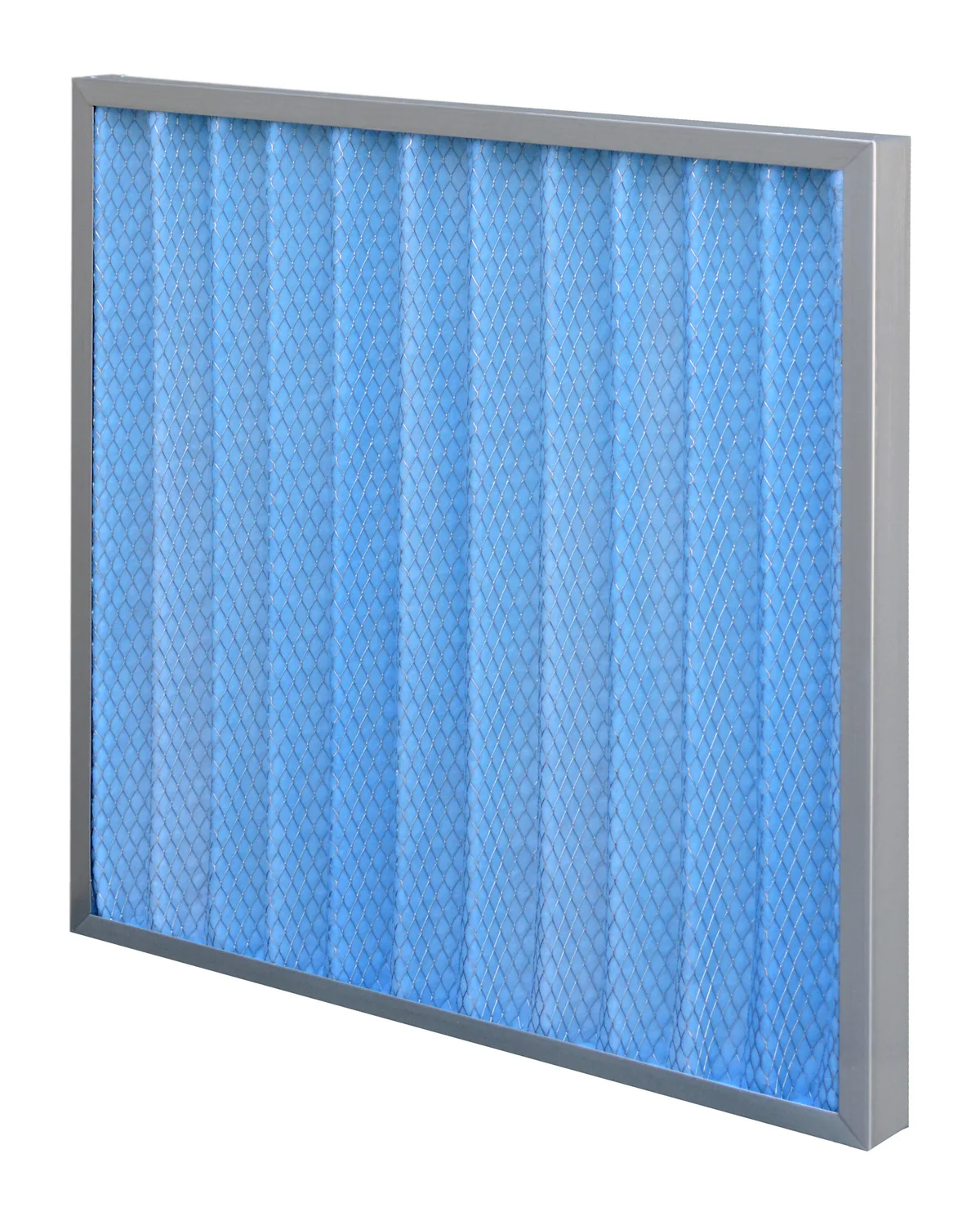
Construction
How a panel filter is built.
The frame can be cardboard for disposable use or metal for a stronger, longer-lived panel. The media is usually synthetic, and the pleats are held at a fixed spacing so the airflow stays even. Panels are thin, from a few tens of millimetres to around 100 mm deep, which is why they fit racks that cannot take a bag or a V-bank.
| Construction | Pleated or flat media in a rectangular frame, normally 25 to about 100 mm deep |
|---|---|
| Frame | Cardboard for disposable use, metal for a stronger panel and a better seal |
| Classes to ask about | ISO Coarse and ePM10 (old EN 779 G-classes) as pre-filters |
| Cleaning | Not washable: replace on pressure drop |
| What we need from you | Width × height × depth in mm, class, quantity |
Performance and care
What to expect, and how to look after it.
Performance and limits
Most panel filters sit in the coarse and ePM10 range of ISO 16890. They are a good dust holder for their price, but they are not the answer to fine particles. When a building needs to remove PM2.5 or PM1, a panel is the protective first stage and a bag or compact filter does that work behind it.
Fitting and replacement
Replace a panel on the pressure drop across it rather than on the calendar, where you can measure it. A blocked panel starves the unit of air, and a panel that has been left in too long can release trapped dust or tear at the pleats. We confirm the exact rating for your order.
Where it is used
Where panel filters are used.
Pre-filter in air handling units
A panel filter at the intake takes the larger dust, lint and insects so the finer, more expensive stage behind it lasts longer.
Offices, schools and shops
General ventilation and comfort cooling, where the aim is cleaner supply air and a clean coil rather than a controlled environment.
Split and ducted air conditioning
Panels are cut or made to the size of the return-air grille or the filter rack.
Industrial extract and make-up air
Coarse dust from workshops, packing halls and warehouses is stopped before it reaches fans and heat exchangers.
Spray booths and ovens, as an intake stage
A disposable panel keeps shop dust out of the air entering the process.
Choosing
This type, or a different one.
Choose it when
Choose a panel filter when you need a low-cost first stage in front of a finer filter, when the rack is shallow, or when the job is general ventilation with no tight air-quality target. It is also the usual choice for return-air grilles and split units.
Choose another type when
Choose a bag or compact filter when the air must be fine-filtered, a metal filter when the filter has to be washed, and a fan-coil filter when the housing is a fan-coil unit with a thin slot.
How to specify
Four details are enough to price a filter.
Send these four and a person can check the request. If one is missing, send what you have: a photo of the old filter and its label often fills the gaps.
- 01
Size
Width × height × depth in millimetres, for example 592 × 592 × 292. Measure the frame of the old filter or the opening it sits in. If the old filter has been squeezed into its slot, measure the slot. Standard and custom sizes are both possible, so send exact figures.
- 02
Class
Tell us the class you need (ISO 16890 or EN 1822). If your paperwork uses the older EN 779 names, such as G4 or F7, send those and we will match them. If you do not know the class, send the label of the filter you use now.
- 03
Quantity
How many of each size, and whether this is a one-off order or a regular one. A mixed list is fine, with one line per size.
- 04
Application and airflow
What the filter sits in, such as an air handling unit, a fan-coil unit, an oven or a cleanroom ceiling, and the airflow in cubic metres per hour if you have it. Add the temperature, the humidity and anything unusual in the air, such as grease, oil or chemicals.
A person checks every request. We tell you what matches, what differs and what we could not confirm, and we confirm the exact rating for your order.
Filter desk
Ask about panel filters. A person replies.
The request form below is set to air filters and to this type. Give the size, the class and the quantity, add a photo of the old filter if you have one, and send it. A person reads every request, checks the details against the TAF range and replies by phone, WhatsApp or email.
Not sure this is the right type? Leave it as it is and say what the filter is for. We will tell you if another type fits better.
Questions
Panel filters: common questions.
Are panel filters washable?
Standard disposable panels are not. Washing breaks down the media and the fibre bond. If you want a cleanable coarse filter, a metal mesh filter is the type designed for it. Tell us the application and we will say which of the two suits it.
How deep should a panel filter be?
As deep as the filter rack takes. A deeper panel has more media for the same face size, so it holds more dust and runs at a lower resistance, but only if the rack and the door allow it. Measure the slot depth, not the depth of the old filter, because old filters are sometimes squeezed in.
Which class do I ask for?
For a pre-filter, a coarse or ePM10 class is usual. If the panel is the only filter, you will want a higher class to protect the occupants. Tell us the class you need under ISO 16890, or the older G4 name if that is what you have, and we will confirm the match.
Cardboard frame or metal frame?
Cardboard frames suit clean, dry, low-pressure air and low cost. A metal frame is stronger, handles higher airflow and damp air better, and gives a more reliable seal in the rack. If the air is humid, hot or dirty, say so when you ask.