Air filters · Type 04 of 08
Compact filters
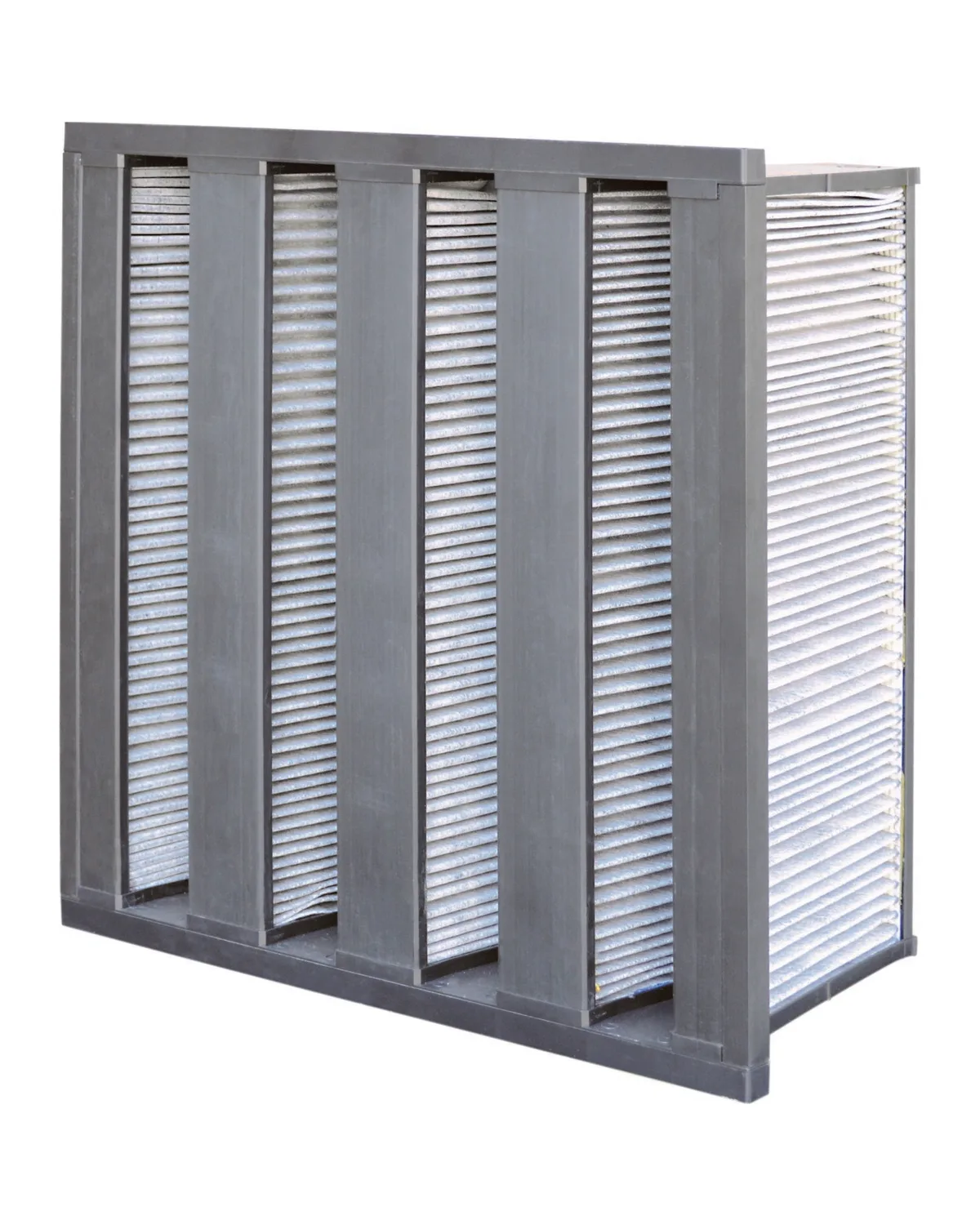
A compact filter, sometimes called a V-bank or V-cell filter, has rigid pleated media packs set at an angle in a frame so they form a W or a V when seen from above. Because the packs are angled, the media area is large for the face of the filter, and the body is short. It is a high-capacity, fine-dust filter built for tight housings.
- Drawing
- AKS-AF-COMPACT
- Sheet
- 10 / 17
- Rev
- 2026-11-16
Construction
How a compact filter is built.
The frame is rigid and often plastic or metal, and the media is a fine synthetic or glass fibre. Unlike a bag filter, nothing hangs in the airflow and nothing can flap, so a compact filter keeps its shape at higher airflow and under fluctuating pressure. That stability is one reason it is used in hospitals and cleanrooms.
| Construction | Rigid pleated V-banks in a frame, short for the media area |
|---|---|
| Media | Fine synthetic or glass fibre |
| Classes to ask about | ePM10, ePM2.5 and ePM1 (old F7 to F9) |
| Housing need | A flat, sealed seat, with a gasket or clamp where required |
| What we need from you | Face size, depth available, class, airflow, quantity |
Performance and care
What to expect, and how to look after it.
Performance and limits
Compact filters cover the fine-dust groups of ISO 16890, from ePM10 up to ePM1. The more V-packs a filter has, the larger the media area and the lower the resistance at a given airflow. You do not need to count them: give us the face size, the depth of the housing and the airflow, and we will say what is offered.
Fitting and replacement
Check the housing before you order. The filter needs a flat, sealed seat so air cannot slip around the frame, and a gasket or clamp where the housing calls for one. If you are replacing bag filters with compact filters to save length, send both the old and the new envelope sizes and we will check the fit.
Where it is used
Where compact filters are used.
Air handling units with limited depth
A compact filter gives the media area of a bag filter in a body that is a fraction of the length.
Hospitals and laboratories
Fine filtration at ePM1 or ePM2.5 levels in the air handling unit, ahead of a terminal HEPA stage.
Pharmaceutical and food production
A rigid filter that holds its shape under the pressure swings of a production hall.
Data centres and electronics halls
Particles in the supply air settle on boards and drives, so a fine primary filter pays for itself in fewer failures.
Gas turbine and compressor intakes
V-bank filters carry high airflows through a short, rigid housing.
Choosing
This type, or a different one.
Choose it when
Choose a compact filter when the housing is short, when the pressure fluctuates, or when you want a rigid body that keeps its shape at high airflow. It is common in hospitals, laboratories and production halls.
Choose another type when
Choose a bag filter when the housing is deep and cost matters more than length, and HEPA when the class is set by a cleanroom standard. A panel filter suits only a coarse stage.
How to specify
Four details are enough to price a filter.
Send these four and a person can check the request. If one is missing, send what you have: a photo of the old filter and its label often fills the gaps.
- 01
Size
Width × height × depth in millimetres, for example 592 × 592 × 292. Measure the frame of the old filter or the opening it sits in. If the old filter has been squeezed into its slot, measure the slot. Standard and custom sizes are both possible, so send exact figures.
- 02
Class
Tell us the class you need (ISO 16890 or EN 1822). If your paperwork uses the older EN 779 names, such as G4 or F7, send those and we will match them. If you do not know the class, send the label of the filter you use now.
- 03
Quantity
How many of each size, and whether this is a one-off order or a regular one. A mixed list is fine, with one line per size.
- 04
Application and airflow
What the filter sits in, such as an air handling unit, a fan-coil unit, an oven or a cleanroom ceiling, and the airflow in cubic metres per hour if you have it. Add the temperature, the humidity and anything unusual in the air, such as grease, oil or chemicals.
A person checks every request. We tell you what matches, what differs and what we could not confirm, and we confirm the exact rating for your order.
Filter desk
Ask about compact filters. A person replies.
The request form below is set to air filters and to this type. Give the size, the class and the quantity, add a photo of the old filter if you have one, and send it. A person reads every request, checks the details against the TAF range and replies by phone, WhatsApp or email.
Not sure this is the right type? Leave it as it is and say what the filter is for. We will tell you if another type fits better.
Questions
Compact filters: common questions.
Compact or bag: which is better?
Neither is better in general. Bag filters are the economical choice when the housing is deep. Compact filters win when the housing is short, when the pressure swings, or when a rigid body is wanted. Send the housing depth and the airflow and we will say which one is the more sensible.
Can I replace bag filters with compact filters?
Often yes, if the face size matches and the housing offers a flat, sealed seat. The compact body is shorter, so check the frame, the gasket and the clamp arrangement. We can compare the old and the new envelope sizes for you before you order.
Which classes are common?
Compact filters are mostly used in the fine-dust groups, ePM10 to ePM1 under ISO 16890, and in the older F7 to F9 names. Tell us the class you need and the application, and we will confirm the exact rating for your order.
Can compact filters be washed?
No. The fine media is not designed for washing and loses efficiency if it is wetted and dried. Replace them on pressure drop. If you want a washable stage upstream, a metal filter in front takes the coarse load.